
Read Nutrition Labels Like an Expert
Low-Carb University, Chapter Four

Chapter Three went through the baking shelf one flour at a time, and this chapter covers the label on every product. The front of a box is written to sell, while the Nutrition Facts table and the ingredient list on the back are the parts Canadian food law regulates, so they’re where a low-carb shopper finds out whether a product belongs in the pantry at all.
The sections below explain what the carbohydrate line on a Canadian label includes, how to work out net carbs from it, and how the serving size changes every number on the table.
They also cover what the ingredient list shows that the table doesn’t, how Canadian labels differ from American ones, and what the front-of-package symbol required since January 1, 2026, does and doesn’t say about a low-carb product.
What Carbohydrate Includes
The carbohydrate figure on a Canadian Nutrition Facts table is a total, and the Canadian Food Inspection Agency (CFIA) requires it to include each of the following:
- Sugars have their own line under carbohydrate, with a % Daily Value beside it.
- Dietary fibre has its own line there as well, with a % Daily Value.
- Starch has no line of its own and is counted only in the total.
- Sugar alcohols get a line when a manufacturer adds them, either named individually (erythritol, for example) or grouped as “sugar alcohols” or “polyols.”
- Glycerol and polydextrose have no line of their own and turn up in some protein bars and sugar-free products.
Starch, which breaks down into glucose during digestion, makes up most of whatever remains of the total once fibre, sugars and any sugar alcohols are accounted for. A cracker can show 1 g of sugars and still carry 20 g of carbohydrate, so on a low-carb diet the carbohydrate line says more than the sugars line does.
Working Out Net Carbs
A Canadian label can’t show net carbs, so the arithmetic is up to the shopper.
The CFIA doesn’t accept “net carbohydrate,” “effective carbohydrate,” “digestible carbs” or similar terms on food packaging, because there’s no scientific agreement on how to define them and they can mislead shoppers, and it doesn’t permit “low carbohydrate” as a claim either.
A manufacturer can only state a plain quantity, such as the grams of carbohydrate in a serving.
Any net carb number on a brand’s website, a product listing or American packaging follows that company’s own formula. The Nutrition Facts table uses one set of rules for every product, so every calculation starts there.
The basic calculation subtracts fibre from carbohydrate, and counting methods differ on whether to subtract sugar alcohols as well. For a bar listing 22 g of carbohydrate, 12 g of fibre and 8 g of erythritol, subtracting fibre only leaves 10 g of net carbs, and subtracting the erythritol as well leaves 2 g.
Sugar alcohols raise blood sugar less than sugar does, and the types differ widely.
Erythritol has almost no effect on blood sugar, while maltitol raises it noticeably (Chapter Twelve of the series compares them in detail). For that reason the fibre-only method is the safer starting point for anyone managing diabetes, and a glucose meter reading after eating a product shows whether its sugar alcohols can be subtracted as well.
When neither method reproduces the net carb number a brand advertises, the figures on the table are the ones to count.
Serving Size Comes First
Every number on the table applies to the serving size printed at the top.
Health Canada bases that serving on a reference amount for each kind of food, meant to reflect what people eat in one sitting, and keeps serving sizes close to it so similar products can be compared. A package holding up to twice the reference amount, such as a single bar or a small bag of chips, has to list the whole package as one serving.
Even so, the serving on the label isn’t always the portion that ends up on the plate. Eating twice the listed serving doubles the figures, fibre included, so a 10 g net carb snack becomes a 20 g one.
Serving sizes can also differ between two similar products, and dividing carbohydrate by grams puts them on equal footing.
A cracker with 6 g of carbohydrate in a 20 g serving carries 0.3 g per gram, while one with 8 g in a 30 g serving carries about 0.27 g per gram. The second cracker is lower in carbs even though its label shows the bigger number.
The Ingredient List
Ingredients are listed in descending order by weight, measured as they go into the mixing bowl, and the list names the sources of carbohydrate that the table only totals up. It’s often the better tool for comparing two versions of the same product, since it shows which flour, starch or sweetener each one is built on.
Under labelling rules Health Canada introduced in 2016, sugars-based ingredients are grouped together after the word “Sugars,” with the individual sugars in brackets from heaviest to lightest, instead of as separate entries spread through the list. The group covers honey, maple syrup, agave syrup, fruit juice concentrates and anything ending in “-ose,” such as glucose-fructose and dextrose.
Grouping pulls sugar toward the front of the list, so the position of the word “Sugars” shows how big a share of the product it makes up.
Sugar alcohols such as maltitol don’t count as sugars under these rules, and neither do sweeteners like steviol glycosides or aspartame, so each one appears under its own name. A sugar-free chocolate can list maltitol as its first ingredient with no “Sugars” group anywhere on the package.
The grouping also isn’t required when the table shows 0 g of sugars. The CFIA’s own example is a seasoning mix that lists maltodextrin, a sugars-based ingredient made from starch, on its own, so a 0 g sugars line doesn’t mean maltodextrin is absent.
Starches and flours add carbohydrate without ever appearing in the Sugars group. The common ones on low-carb shelves are these:
- Tapioca starch, potato starch and modified corn starch thicken sauces and give gluten-free baked goods their texture.
- Rice flour and wheat flour turn up in crackers, coatings and breading.
- Cornmeal and corn flour are the base of tortilla chips and taco shells.
Processed meats, pickled vegetables and sweetened plant milks often contain added sugar as well, and the ingredient list is the only place it’s named.
American Labels Compared
American and Canadian tables count carbohydrate the same way, but they differ in how they label and report it:
- The carbohydrate line is called “Total Carbohydrate” on the American table and “Carbohydrate” on the Canadian one.
- The American table has an added sugars line with its own % Daily Value, and the Canadian table shows total sugars only.
- Sugar alcohols are optional on the American table, and the Canadian table requires a sugar alcohol line whenever they’re added.
European labels work differently again, because under EU rules carbohydrate covers only what the body metabolises and fibre sits outside the total. A carbohydrate figure on a European label needs no subtraction to get to net carbs, but it still includes any sugar alcohols, so it matches the fibre-only method.
The Front-of-Package Symbol
Since January 1, 2026, prepackaged foods that are high in saturated fat, sugars or sodium have to carry a symbol with a magnifying glass on the front of the package. “High” is measured as a percentage of the Daily Value per serving or per reference amount, whichever is larger.
Most foods carry the symbol at 15% or more, foods with a reference amount of 30 g or less (cookies, salad dressings and pickles, for example) carry it at 10%, and main dishes with a reference amount of 200 g or more carry it at 30%.
Carbohydrate isn’t one of the three nutrients, so the symbol says nothing about it. A bag of plain, unsalted rice cakes can be free of the symbol and still be mostly starch, and a sugar-free candy sweetened with maltitol won’t be flagged for sugars either.
A product that suits a keto diet perfectly well can still carry a “high in saturated fat” marker, because fat bombs and coconut-based snacks get much of their energy from coconut oil, butter or cocoa butter, and all three are mostly saturated fat.
Health Canada exempts some foods it considers to have a healthy fat profile, including vegetable oils, nuts and fatty fish, along with some cheeses that meet a calcium requirement (exempt for their naturally occurring saturated fat), but a processed keto snack isn’t on that list.
Anyone following a doctor’s advice on saturated fat or sodium can still use the symbol to spot products high in either.
Back to the Pantry
The pantry inventory suggested in the series introduction sorted products into four piles. The checks in this chapter settle three of them, covering sugar near the front of the ingredient list, serving sizes smaller than a real portion, and net carb claims that can’t be reproduced from the table.
Product pages on The Low Carb Grocery have a Nutrition Facts tab, so shoppers can read the label before ordering. Shipping is free across Canada on orders over $99 (some rural addresses are excluded), and local GTA delivery is free on orders over $69.
The team answers questions about a specific product’s label through the contact page.
Chapter Five puts common high-carb staples side by side with the low-carb products that replace them.


Explore Our Popular Shopping Categories


More Low Carb Lifestyle Articles
Low Carb University: Everyday Alternatives
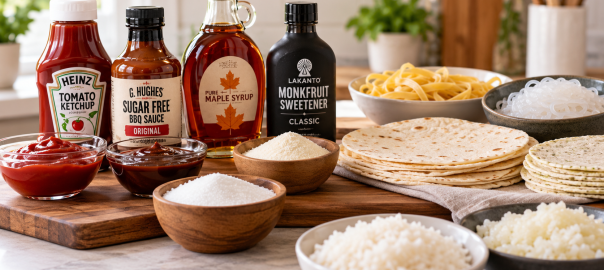
We compared common staples with their low-carb replacements at the same serving. Regular ketchup has 10 g of net carbs per two tablespoons, and Crazy Mooskies has 1 g. Cooked spaghetti has 26 g per 100 g, and nuPasta konjac fettuccine has none. The full chapter covers sauces, syrup, tortillas, pasta, rice and breadcrumbs, plus which swaps to start with.

Low Carb University: Nutrition Labels
Canadian labels can’t show net carbs, so the math falls to you. Our latest chapter covers what’s inside the carbohydrate line, how to calculate net carbs, and how to spot sugar in the ingredient list. It also explains why a keto snack can still carry a “high in saturated fat” symbol. Read on to learn more.
Low Carb University: The Baking Shelf
Low-Carb Pantry University, Chapter Three: the baking shelf. A quarter cup of coconut flour replaces a full cup of wheat flour. One tablespoon of flaxseed meal and three of water makes an egg. Half a teaspoon of xanthan gum thickens a cup of liquid. Every ingredient on that shelf is replacing one specific thing wheat flour and sugar used to do. Our new guide explains which is which.
Low Carb University: 25 Pantry Staples
Twenty-five low-carb staples, sorted by what they actually do. Bread at 1g net carbs a slice. A full plate of pasta for 25 calories. Sauces with the sugar taken out. Protein you can eat straight from the bag. Every entry lists its carb count and how long it keeps once opened. Chapter Two of Low-Carb Pantry University is on the blog now.

Low Carb University: Building Your Pantry
Most first low-carb grocery orders are too big. Three sweeteners, four flours, and a month later half of it is unopened. Our new pantry guide covers what’s actually in each category, which products to start with, and the five items that will carry you through a month of cooking. Sweeteners, flours, bread, pasta, condiments, spreads, chocolate and snacks, all in one place.